This is about obtaining a di
fferent level of
consciousness. Consider, for example, scented
candles. Today there are ever more of these.
They are, of course, a very simple trigger.
But the interesting thing is that fragrance
outwits our cognitive system. You smell
something and are immediately in a different
emotional state. It’s a trigger that reaches
more quickly into the subconscious. At the
same time, these days we also have ever
greater difficulty in “letting go”, despite the
fact that we recognise how important this is
for us. In this context, I believe that the e
ffect
of sound is largely underestimated.
In principle, it works in a similar way to
fragrance. This is why people go to disco
theques. To dance in exhilaration, in a trance.
Or at least to forget everyday life a little.
Now, of course I do not want to go into the
bathroom and listen to Techno or Trance.
However, you can very quickly access the
subconscious with the right sound structures.
Think, for example, of the 1970s and Brian
Eno. Or John Cage. This is still a very special
area of the avantgarde. I am equally fasci
nated by the singing bowls made from pure
brass that are found in Tibetan Temples.
These bowls have an incredible density,
simplicity and purity. “Noises for Ritual
Architecture” is not about listening to music
in the classical sense. It is more about a room
temperature, a perfume, that you are really
184
only consciously aware of once it is over. You
go in and immediately feel embraced by a
kind of energy field. There are no conventional
harmonic progressions. Sometimes it is simply
noise. That is the reason for the title “Noises
for Ritual Architecture”. It is not like a mas
sage, where you feel as if you are going to fall
asleep because you hear a beautiful harmony
of the spheres or waves. Rather, you feel: here
comes a sound from the future, that forms a
kind of microcosm. Weaving the threads of a
tale that is so abstract that it inspires you to be
creative yourself, to fantasise.
“The ritual
bathroom is, in
principle, a kind of
architectural
amplifier, which
makes the formal
message of
the fittings even
clearer.”
At your instigation, a collaboration was also
set up between Dornbracht and the renowned
ETH Zurich. The objective was announced
as “The development of a discourse on ritual
architecture on the international architectural
scene”.
The MEM bathroom received a lot of attention
on the architectural scene. Maybe that was
one of the triggers that gave the bathroom a
new priority on the agenda for architects.
At this moment in time, Professor Marc
Angélil from ETH Zurich was also involved
with this issue. Dornbracht initiated a research
term on ritual architecture. The students
developed fascinating approaches. For example,
one student even conceived a “Smart House”.
The idea did not exist at the time. Today, it is
on everyone’s lips, because we are confronted
with digital interfaces in almost all areas.
One last question that follows on from this,
Mr Meiré. How is the theme of “Ritual Archi
tecture in the Bathroom” going to develop, in
your opinion? What impact will increasing
digitalisation have, for example?
It has to be said that Steve Jobs created a real
breakthrough with the iPhone and especially
with the App Store. Today, we no longer talk
about the design of the iPhone, we expect it to
be state of the art, to be ever flatter and faster,
we expect that the battery lasts longer and
that the systems are updated. We know that
we are the “Beta Generation”. Thus, the
interesting thing is that we are identifying our
preferences through the App Store, like never
before. I think today that the special feature
of the digital revolution is the move towards
more conscious individuality. I find this really
fascinating. Dornbracht is moving in this
direction with SMART WATER, for example.
Technology as the basis for maximum indi
viduality. This is the trend.
IT
Signor Meiré, Lei alcuni anni fa, a partire
dalla serie di rubinetterie MEM, ha fissato
il concetto di “architettura rituale in bagno”.
Quale ne è stato il fattore scatenante?
Si è trattato di una qualificazione. Avevamo
preso atto che un bagno in linea di principio
non è solo destinato a funzioni specifiche
di depurazione, ma può offrire molto di più.
In quanto vero e proprio spazio vitale. Si ha
la doccia o la vasca da bagno, il lavabo, forse
il gabinetto, il bidet. In generale tutte zone
con una funzione concreta. Questi spazi
riconducono a determinate sequenze di
azioni, a rituali. Mi sono chiesto se fosse
possibile arricchire tali rituali di una compo
nente più mentale. Il bagno come spazio,
in cui quindi non si effettua solo l’igiene del
corpo, bensì come luogo, in cui si possono
esplorare determinate esperienze quotidiane.
Una sorta di purificazione mentale. Il posto
per appropriarsi di se stessi, il proprio tempio.
Solitamente il bagno una volta non aveva
nemmeno una finestra. Cosa succede allora
se si annette questo spazio a un giardino, a un
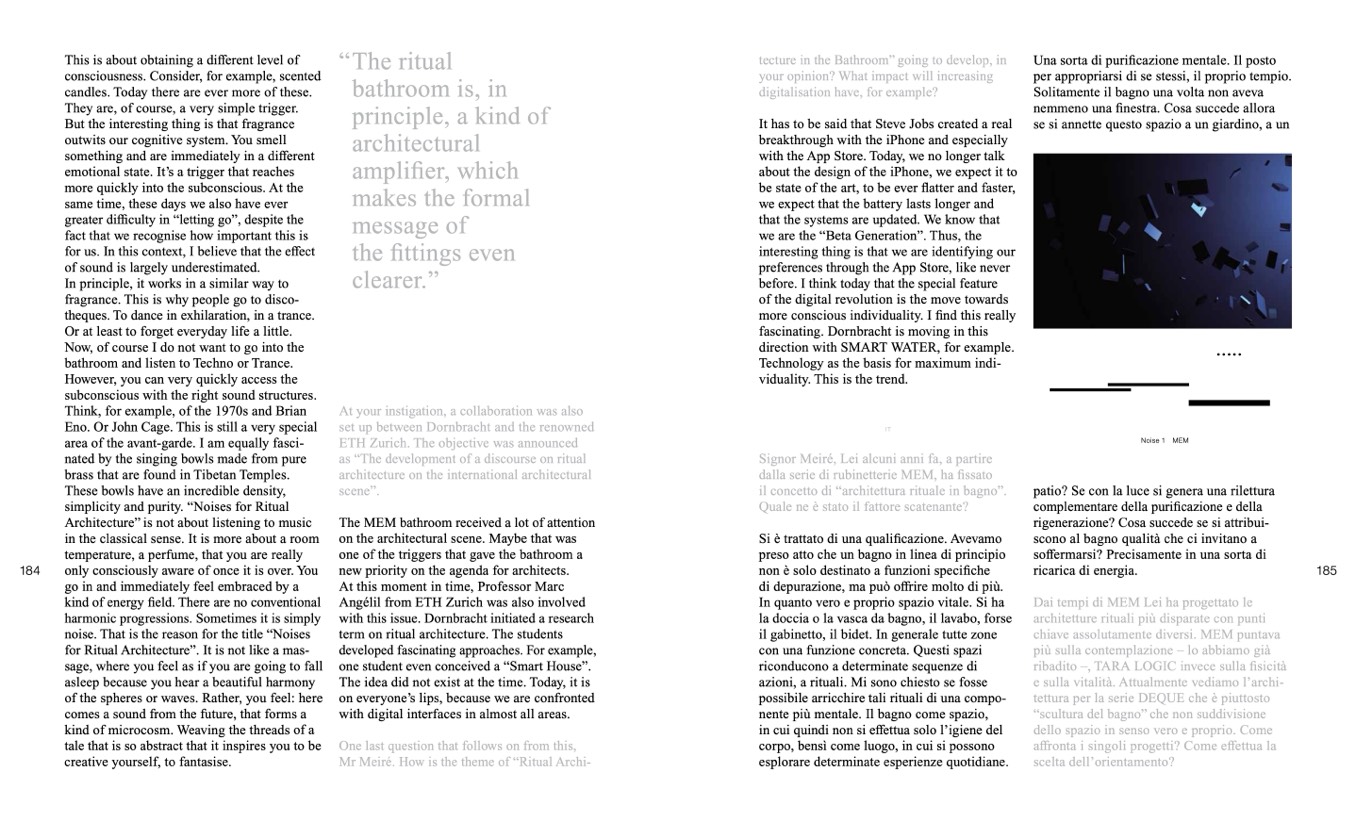
Noise 1 MEM
patio? Se con la luce si genera una rilettura
complementare della purificazione e della
rigenerazione? Cosa succede se si attribui
scono al bagno qualità che ci invitano a
soffermarsi? Precisamente in una sorta di
ricarica di energia.
185
Dai tempi di MEM Lei ha progettato le
architetture rituali più disparate con punti
chiave assolutamente diversi. MEM puntava
più sulla contemplazione – lo abbiamo già
ribadito –, TARA LOGIC invece sulla fisicità
e sulla vitalità. Attualmente vediamo l’archi
tettura per la serie DEQUE che è piuttosto
“scultura del bagno” che non suddivisione
dello spazio in senso vero e proprio. Come
affronta i singoli progetti? Come effettua la
scelta dell’orientamento?

