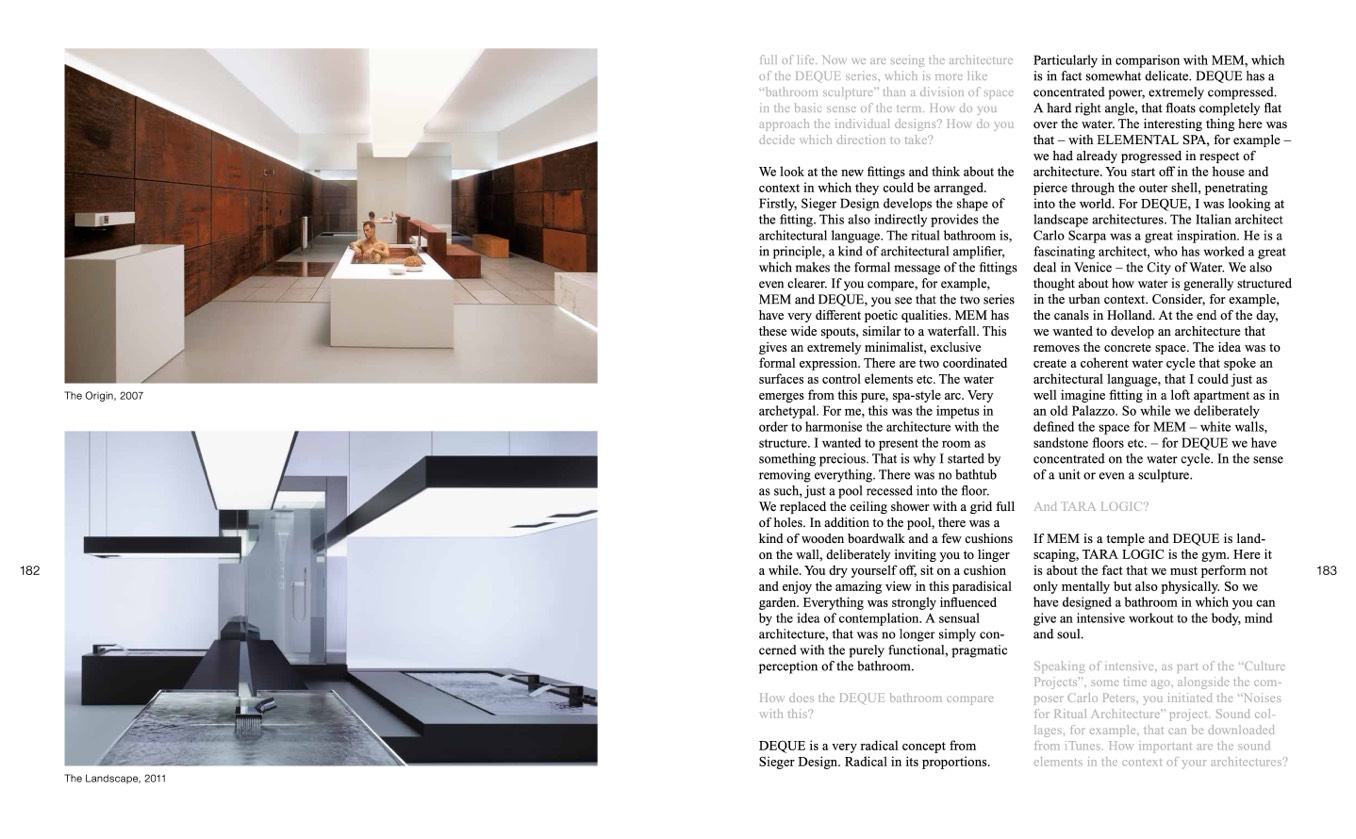
The Origin, 2007
full of life. Now we are seeing the architecture
of the DEQUE series, which is more like
“bathroom sculpture” than a division of space
in the basic sense of the term. How do you
approach the individual designs? How do you
decide which direction to take?
We look at the new fittings and think about the
context in which they could be arranged.
Firstly, Sieger Design develops the shape of
the fitting. This also indirectly provides the
architectural language. The ritual bathroom is,
in principle, a kind of architectural amplifier,
which makes the formal message of the fittings
even clearer. If you compare, for example,
MEM and DEQUE, you see that the two series
have very different poetic qualities. MEM has
these wide spouts, similar to a waterfall. This
gives an extremely minimalist, exclusive
formal expression. There are two coordinated
surfaces as control elements etc. The water
emerges from this pure, spastyle arc. Very
archetypal. For me, this was the impetus in
order to harmonise the architecture with the
structure. I wanted to present the room as
something precious. That is why I started by
removing everything. There was no bathtub
as such, just a pool recessed into the floor.
We replaced the ceiling shower with a grid full
of holes. In addition to the pool, there was a
kind of wooden boardwalk and a few cushions
on the wall, deliberately inviting you to linger
a while. You dry yourself off, sit on a cushion
and enjoy the amazing view in this paradisical
garden. Everything was strongly influenced
by the idea of contemplation. A sensual
architecture, that was no longer simply con
cerned with the purely functional, pragmatic
perception of the bathroom.
How does the DEQUE bathroom compare
with this?
DEQUE is a very radical concept from
Sieger Design. Radical in its proportions.
Particularly in comparison with MEM, which
is in fact somewhat delicate. DEQUE has a
concentrated power, extremely compressed.
A hard right angle, that floats completely flat
over the water. The interesting thing here was
that – with ELEMENTAL SPA, for example –
we had already progressed in respect of
architecture. You start off in the house and
pierce through the outer shell, penetrating
into the world. For DEQUE, I was looking at
landscape architectures. The Italian architect
Carlo Scarpa was a great inspiration. He is a
fascinating architect, who has worked a great
deal in Venice – the City of Water. We also
thought about how water is generally structured
in the urban context. Consider, for example,
the canals in Holland. At the end of the day,
we wanted to develop an architecture that
removes the concrete space. The idea was to
create a coherent water cycle that spoke an
architectural language, that I could just as
well imagine fitting in a loft apartment as in
an old Palazzo. So while we deliberately
defined the space for MEM – white walls,
sandstone floors etc. – for DEQUE we have
concentrated on the water cycle. In the sense
of a unit or even a sculpture.
And TARA LOGIC?
If MEM is a temple and DEQUE is land
scaping, TARA LOGIC is the gym. Here it
is about the fact that we must perform not
183
only mentally but also physically. So we
have designed a bathroom in which you can
give an intensive workout to the body, mind
and soul.
Speaking of intensive, as part of the “Culture
Projects”, some time ago, alongside the com
poser Carlo Peters, you initiated the “Noises
for Ritual Architecture” project. Sound col
lages, for example, that can be downloaded
from iTunes. How important are the sound
elements in the context of your architectures?
182
The Landscape, 2011

