EN
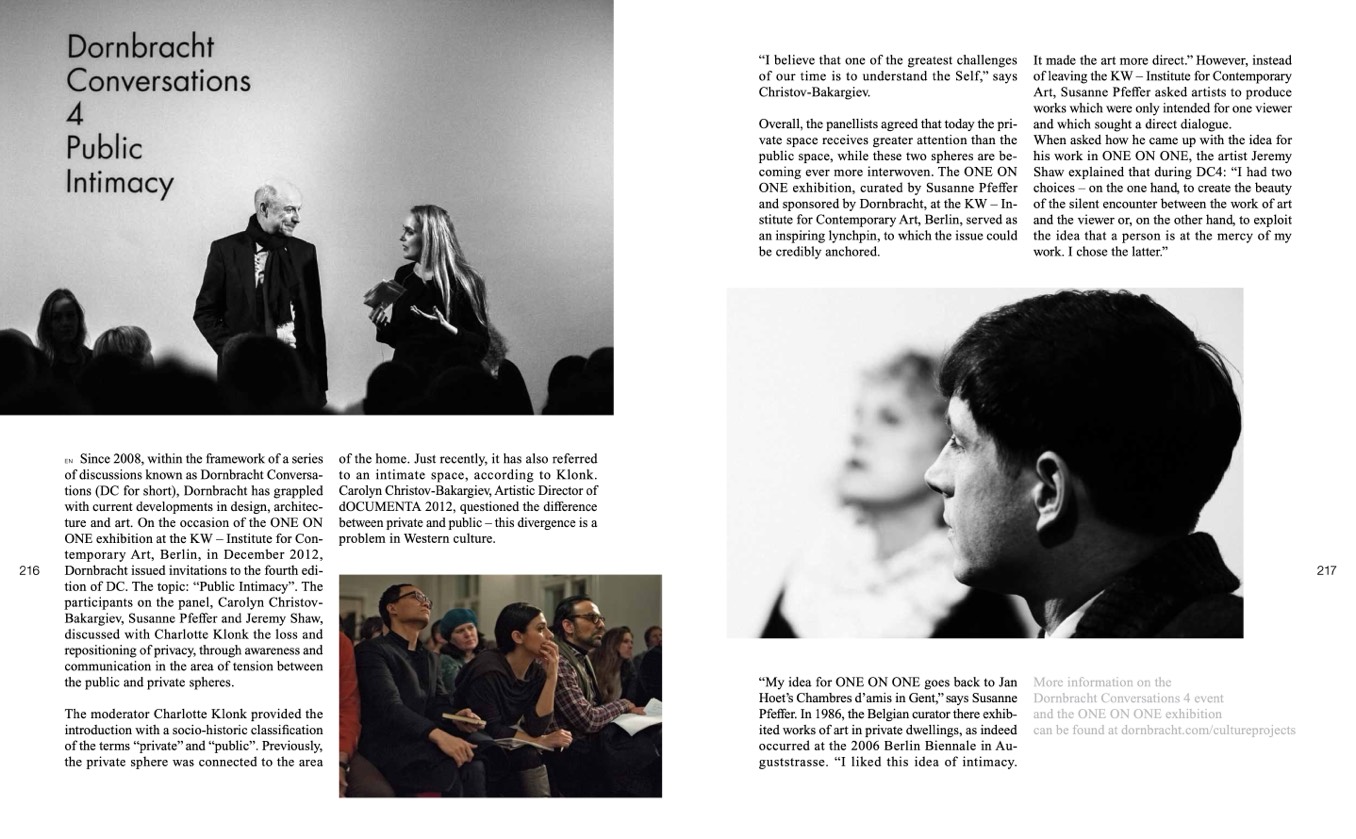
Since 2008, within the framework of a series
of discussions known as Dornbracht Conversa
tions (DC for short), Dornbracht has grappled
with current developments in design, architec
ture and art. On the occasion of the ONE ON
ONE exhibition at the KW – Institute for Con
temporary Art, Berlin, in December 2012,
216
Dornbracht issued invitations to the fourth edi
tion of DC. The topic: “Public Intimacy”. The
participants on the panel, Carolyn Christov
Bakargiev, Susanne Pfeffer and Jeremy Shaw,
discussed with Charlotte Klonk the loss and
repositioning of privacy, through awareness and
communication in the area of tension between
the public and private spheres.
The moderator Charlotte Klonk provided the
introduction with a sociohistoric classification
of the terms “private” and “public”. Previously,
the private sphere was connected to the area
of the home. Just recently, it has also referred
to an intimate space, according to Klonk.
Carolyn ChristovBakargiev, Artistic Director of
dOCUMENTA 2012, questioned the difference
between private and public – this divergence is a
problem in Western culture.
“I believe that one of the greatest challenges
of our time is to understand the Self,” says
ChristovBakargiev.
Overall, the panellists agreed that today the pri
vate space receives greater attention than the
public space, while these two spheres are be
coming ever more interwoven. The ONE ON
ONE exhibition, curated by Susanne Pfeffer
and sponsored by Dornbracht, at the KW – In
stitute for Contemporary Art, Berlin, served as
an inspiring lynchpin, to which the issue could
be credibly anchored.
It made the art more direct.” However, instead
of leaving the KW – Institute for Contemporary
Art, Susanne Pfeffer asked artists to produce
works which were only intended for one viewer
and which sought a direct dialogue.
When asked how he came up with the idea for
his work in ONE ON ONE, the artist Jeremy
Shaw explained that during DC4: “I had two
choices – on the one hand, to create the beauty
of the silent encounter between the work of art
and the viewer or, on the other hand, to exploit
the idea that a person is at the mercy of my
work. I chose the latter.”
217
“My idea for ONE ON ONE goes back to Jan
Hoet’s Chambres d’amis in Gent,” says Susanne
Pfeffer. In 1986, the Belgian curator there exhib
ited works of art in private dwellings, as indeed
occurred at the 2006 Berlin Biennale in Au
guststrasse. “I liked this idea of intimacy.
More information on the
Dornbracht Conversations 4 event
and the ONE ON ONE exhibition
can be found at dornbracht.com/cultureprojects

