33
Recycling
manufacturing waste
Together with the environmental manager, the plant manager
is responsible for implementing circular economy practices
at the site. Wherever possible, waste is processed in a way
that allows it to substitute raw materials. At our production
facility in Meissen, we use materials from what is known as
“glost scrap” for the masf or shaping the ceramic. Finished
ceramic parts that are rejected as unsaleable after firing are
ground up externally and this material is then fed back into
our production process (2024: 518 t).
Similarly, waste residues of the slip produced when emptyin
g
the pipes after the end of production are fed back i
n
directly. A decanter is used to
filter out the fine, valuable ra
w
materials contained in the production water (2024: 181 t).
A similar process is used for the glazing process: the glaz
e
that does not stick to the product during glazing is captured,
prepared, and reused.
A filtration system was installed at the Hornberg plant
mid-2024 to recover raw materials for the slip (133 t). Thi
s
currently corresponds to 3.5% of the raw materials used;
this share is to be increased to 10% by 2040.
In Hornberg we already prepare the residual glaze and
feed this material back to the production process, as is
also the case in Meissen. Because of the different materia
l
compositions, glost scrap cannot be treated in Hornberg.
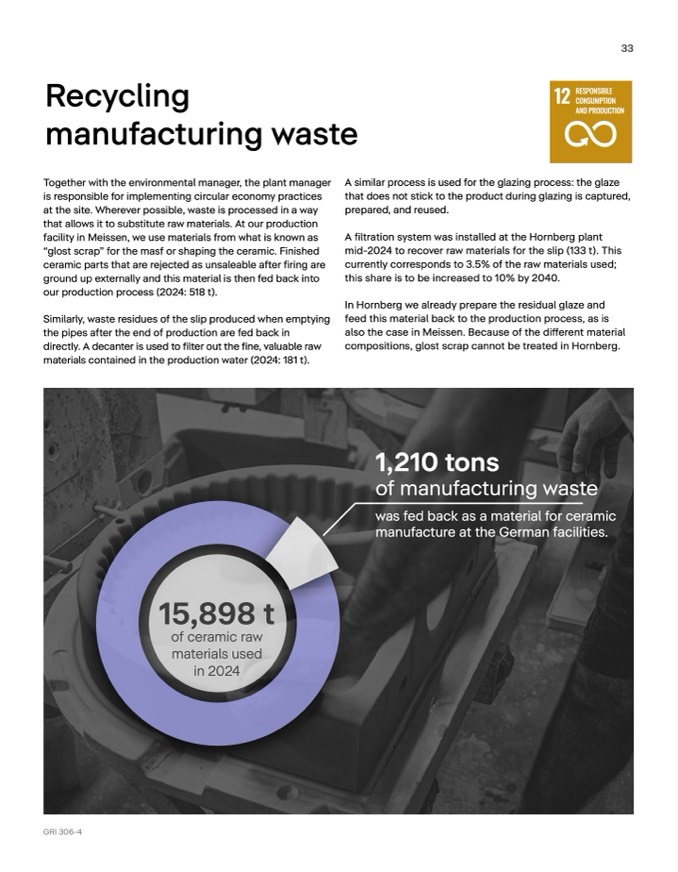
1,210 ton
s
of manufacturing wast
e
was fed back as a material for cerami
c
manufacture at the German facilities
.
15,898 t
of ceramic ra
w
materials used
in 2024
GRI 306-4

