32 Action area Resources | Mine Renaturation
Renaturation
:
habitat for new biodiversit
y
Ceramic manufacturing requires resources and raw materials
,
above all clay, kaolin, quartz and feldspar. For its German
facilities alone, Duravit Germany handled around 4,000 tons
each of clay and kaolin in 2023. Alongside reliable and stable
supply chains, we make sure that we work with responsibl
e
partners such as Imerys, who can demonstrate a high level of
sustainability in their own processes. The key here is th
e
careful and invaluable renaturation of mines and quarries
after the raw materials have been extracted in order to keep
the impacts of the extraction to a minimum
.
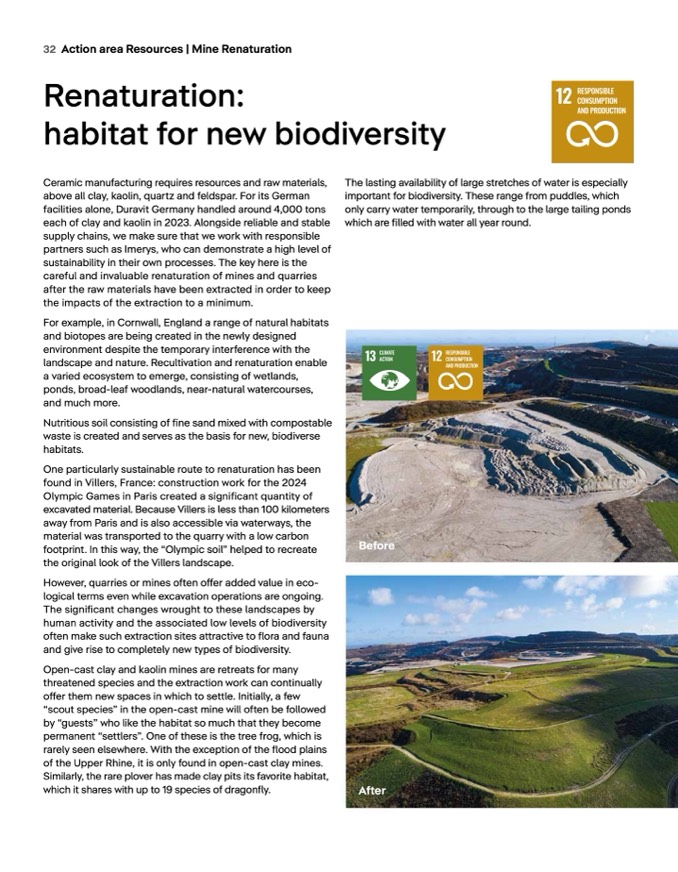
For example, in Cornwall, England a range of natural habitats
and biotopes are being created in the newly designed
environment despite the temporary interference with th
e
landscape and nature. Recultivation and renaturation enable
a varied ecosystem to emerge, consisting of wetlands
,
ponds, broad-leaf woodlands, near-natural watercourses
,
and much more.
Nutritious soil consisting of
fine sand mixed with compostable
waste is created and serves as the basis for new, biodiverse
habitats.
One particularly sustainable route to renaturation has been
found in Villers, France: construction work for the 202
4
Olympic Games in Paris created a significant quantity of
excavated material. Because Villers is less than 100 kilometers
away from Paris and is also accessible via waterways, the
material was transported to the quarry with a low carbon
footprint. In this way, the “Olympic soil” helped to recreat
e
the original look of the Villers landscape
.
However, quarries or mines often offer added value in eco-
logical terms even while excavation operations are ongoing
.
The signi
ficant changes wrought to these landscapes by
human activity and the associated low levels of biodiversity
often make such extraction sites attractive to
flora and fauna
and give rise to completely new types of biodiversity
.
Open-cast clay and kaolin mines are retreats for many
threatened species and the extraction work can continually
offer them new spaces in which to settle. Initially, a fe
w
“scout species” in the open-cast mine will often be followe
d
by “guests” who like the habitat so much that they becom
e
permanent “settlers”. One of these is the tree frog, which i
s
rarely seen elsewhere. With the exception of the flood plains
of the Upper Rhine, it is only found in open-cast clay mines.
Similarly, the rare plover has made clay pits its favorite habitat,
which it shares with up to 19 species of dragon
fly.
The lasting availability of large stretches of water is especially
important for biodiversity. These range from puddles, whic
h
only carry water temporarily, through to the large tailing pond
s
which are filled with water all year round.
Befor
e
After

