160
161
PSP DATI TECNICI / TECHNICAL DATA
TEST PRESTAZIONI / PERFORMANCE'S TEST
PROVE DI CARICO / LOADING CAPACITY TESTS
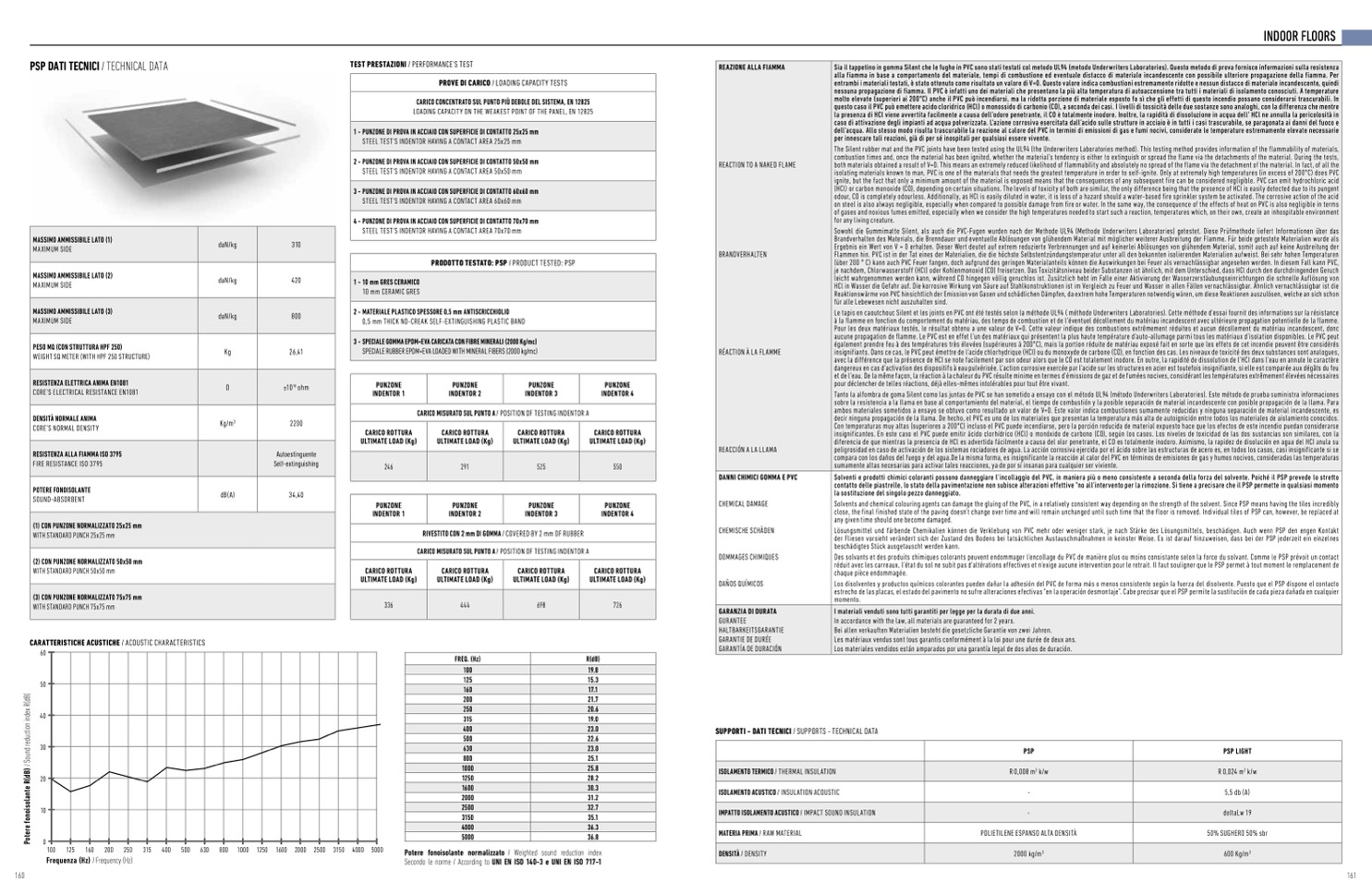
CARATTERISTICHE ACUSTICHE / ACOUSTIC CHARACTERISTICS
60
50
40
30
20
10
0
100
125
160
200 250
315
400 500 630 800 1000 1250 1600 2000 2500 3150 4000 5000
Frequenza (Hz) / Frequency (Hz)
125
15.3
200
21.7
315
19.0
500
22.6
800
25.1
1250
28.2
2000
31.2
3150
35.1
5000
36.8
Potere fonoisolante normalizzato / Weighted sound reduction index
Secondo le norme / According to UNI EN ISO 140-3 e UNI EN ISO 717-1
SUPPORTI - DATI TECNICI / SUPPORTS - TECHNICAL DATA
ISOLAMENTO ACUSTICO / INSULATION ACOUSTIC
MATERIA PRIMA / RAW MATERIAL
PSP
-
POLIETILENE ESPANSO ALTA DENSITÀ
PSP LIGHT
5,5 db (A)
50% SUGHERO 50% sbr
PRODOTTO TESTATO: PSP / PRODUCT TESTED: PSP
INDOOR FLOORS
REAZIONE ALLA FIAMMA
REACTION TO A NAKED FLAME
BRANDVERHALTEN
R
ÉACTION À LA FLAMME
REACCI
ÓN A LA LLAMA
Sia il tappetino in gomma Silent che le fughe in PVC sono stati testati col metodo UL94 (metodo Underwriters Laboratories). Questo metodo di prova fornisce informazioni sulla resistenza
alla fiamma in base a comportamento del materiale, tempi di combustione ed eventuale distacco di materiale incandescente con possibile ulteriore propagazione della fiamma. Per
entrambi i materiali testati, è stato ottenuto come risultato un valore di V=0. Questo valore indica combustioni estremamente ridotte e nessun distacco di materiale incandescente, quindi
nessuna propagazione di fiamma. Il PVC è infatti uno dei materiali che presentano la più alta temperatura di autoaccensione tra tutti i materiali di isolamento conosciuti. A temperature
molto elevate (superiori ai 200°C) anche il PVC può incendiarsi, ma la ridotta porzione di materiale esposto fa s
ì che gli effetti di questo incendio possano considerarsi trascurabili. In
questo caso il PVC pu
ò emettere acido cloridrico (HCl) o monossido di carbonio (CO), a seconda dei casi. I livelli di tossicit
à delle due sostanze sono analoghi, con la differenza che mentre
la presenza di HCl viene avvertita facilmente a causa dell’odore penetrante, il CO è totalmente inodore. Inoltre, la rapidità di dissoluzione in acqua dell’ HCl ne annulla la pericolosità in
caso di attivazione degli impianti ad acqua polverizzata. L'azione corrosiva esercitata dall’acido sulle strutture in acciaio è in tutti i casi trascurabile, se paragonata ai danni del fuoco e
dell'acqua. Allo stesso modo risulta trascurabile la reazione al calore del PVC in termini di emissioni di gas e fumi nocivi, considerate le temperature estremamente elevate necessarie
per innescare tali reazioni, già di per sé inospitali per qualsiasi essere vivente.
The Silent rubber mat and the PVC joints have been tested using the UL94 (the Underwriters Laboratories method). This testing method provides information of the flammability of materials,
combustion times and, once the material has been ignited, whether the material’s tendency is either to extinguish or spread the flame via the detachments of the material. During the tests,
both materials obtained a result of V=0. This means an extremely reduced likelihood of flammability and absolutely no spread of the flame via the detachment of the material. In fact, of all the
isolating materials known to man, PVC is one of the materials that needs the greatest temperature in order to self-ignite. Only at extremely high temperatures (in excess of 200°C) does PVC
ignite, but the fact that only a minimum amount of the material is exposed means that the consequences of any subsequent fire can be considered negligible. PVC can emit hydrochloric acid
(HCl) or carbon monoxide (CO), depending on certain situations. The levels of toxicity of both are similar, the only difference being that the presence of HCl is easily detected due to its pungent
odour, CO is completely odourless. Additionally, as HCl is easily diluted in water, it is less of a hazard should a water-based fire sprinkler system be activated. The corrosive action of the acid
on steel is also always negligible, especially when compared to possible damage from fire or water. In the same way, the consequence of the effects of heat on PVC is also negligible in terms
of gases and noxious fumes emitted, especially when we consider the high temperatures needed to start such a reaction, temperatures which, on their own, create an inhospitable environment
for any living creature.
Sowohl die Gummimatte Silent, als auch die PVC-Fugen wurden nach der Methode UL94 (Methode Underwriters Laboratories) getestet. Diese Prüfmethode liefert Informationen
über das
Brandverhalten des Materials, die Brenndauer und eventuelle Ablösungen von glühendem Material mit möglicher weiterer Ausbreitung der Flamme. Für beide getestete Materialien wurde als
Ergebnis ein Wert von V = 0 erhalten. Dieser Wert deutet auf extrem reduzierte Verbrennungen und auf keinerlei Abl
ösungen von glühendem Material, somit auch auf keine Ausbreitung der
Flammen hin. PVC ist in der Tat eines der Materialien, die die höchste Selbstentzündungstemperatur unter all den bekannten isolierenden Materialien aufweist. Bei sehr hohen Temperaturen
(über 200 ° C) kann auch PVC Feuer fangen, doch aufgrund des geringen Materialanteils können die Auswirkungen bei Feuer als vernachlässigbar angesehen werden. In diesem Fall kann PVC,
je nachdem, Chlorwasserstoff (HCl) oder Kohlenmonoxid (CO) freisetzen. Das Toxizitätsniveau beider Substanzen ist ähnlich, mit dem Unterschied, dass HCl durch den durchdringenden Geruch
leicht wahrgenommen werden kann, während CO hingegen völlig geruchlos ist. Zusätzlich hebt im Falle einer Aktivierung der Wasserzerstäubungseinrichtungen die schnelle Auflösung von
HCl in Wasser die Gefahr auf. Die korrosive Wirkung von Säure auf Stahlkonstruktionen ist im Vergleich zu Feuer und Wasser in allen Fällen vernachlässigbar.
Ähnlich vernachlässigbar ist die
Reaktionswärme von PVC hinsichtlich der Emission von Gasen und schädlichen Dämpfen, da extrem hohe Temperaturen notwendig wären, um diese Reaktionen auszulösen, welche an sich schon
für alle Lebewesen nicht auszuhalten sind.
Le tapis en caoutchouc Silent et les joints en PVC ont été testés selon la m
éthode UL94 ( méthode Underwriters Laboratories). Cette méthode d'essai fournit des informations sur la résistance
à la flamme en fonction du comportement du matériau, des temps de combustion et de l'éventuel d
écollement du matériau incandescent avec ultérieure propagation potentielle de la flamme.
Pour les deux matériaux testés, le résultat obtenu a une valeur de V=0. Cette valeur indique des combustions extrêmement réduites et aucun d
écollement du matériau incandescent, donc
aucune propagation de flamme. Le PVC est en effet l'un des matériaux qui présentent la plus haute temp
érature d'auto-allumage parmi tous les matériaux d'isolation disponibles. Le PVC peut
également prendre feu à des températures très élevées (supérieures
à 200°C), mais la portion r
éduite de matériau exposé fait en sorte que les effets de cet incendie peuvent être considérés
insignifiants. Dans ce cas, le PVC peut émettre de l'acide chlorhydrique (HCI) ou du monoxyde de carbone (CO), en fonction des cas. Les niveaux de toxicité des deux substances sont analogues,
avec la différence que la pr
ésence de HCI se note facilement par son odeur alors que le CO est totalement inodore. En outre, la rapidité de dissolution de l'HCI dans l'eau en annule le caract
ère
dangereux en cas d'activation des dispositifs à eau pulvéris
ée. L'action corrosive exercée par l'acide sur les structures en acier est toutefois insignifiante, si elle est compar
ée aux dégâts du feu
et de l'eau. De la même façon, la réaction à la chaleur du PVC résulte minime en termes d'émissions de gaz et de fumées nocives, consid
érant les températures extrêmement élevées nécessaires
pour déclencher de telles réactions, déjà elles-mêmes intol
érables pour tout être vivant.
Tanto la alfombra de goma Silent como las juntas de PVC se han sometido a ensayo con el método UL94 (método Underwriters Laboratories). Este método de prueba suministra informaciones
sobre la resistencia a la llama en base al comportamiento del material, el tiempo de combustión y la posible separación de material incandescente con posible propagación de la llama. Para
ambos materiales sometidos a ensayo se obtuvo como resultado un valor de V=0. Este valor indica combustiones sumamente reducidas y ninguna separación de material incandescente, es
decir ninguna propagación de la llama. De hecho, el PVC es uno de los materiales que presentan la temperatura más alta de autoignición entre todos los materiales de aislamiento conocidos.
Con temperaturas muy altas (superiores a 200°C) incluso el PVC puede incendiarse, pero la porción reducida de material expuesto hace que los efectos de este incendio puedan considerarse
insignificantes. En este caso el PVC puede emitir ácido clorh
ídrico (HCl) o mon
óxido de carbono (CO), seg
ún los casos. Los niveles de toxicidad de las dos sustancias son similares, con la
diferencia de que mientras la presencia de HCl es advertida fácilmente a causa del olor penetrante, el CO es totalmente inodoro. Asimismo, la rapidez de disolución en agua del HCI anula su
peligrosidad en caso de activación de los sistemas rociadores de agua. La acción corrosiva ejercida por el ácido sobre las estructuras de acero es, en todos los casos, casi insignificante si se
compara con los daños del fuego y del agua.De la misma forma, es insignificante la reacción al calor del PVC en términos de emisiones de gas y humos nocivos, consideradas las temperaturas
sumamente altas necesarias para activar tales reacciones, ya de por sí insanas para cualquier ser viviente.
DANNI CHIMICI GOMMA E PVC
CHEMICAL DAMAGE
CHEMISCHE SCH
ÄDEN
DOMMAGES CHIMIQUES
DAÑOS QUÍMICOS
Solventi e prodotti chimici coloranti possono danneggiare l’incollaggio del PVC, in maniera pi
ù o meno consistente a seconda della forza del solvente. Poiché il PSP prevede lo stretto
contatto delle piastrelle, lo stato della pavimentazione non subisce alterazioni effettive "no all’intervento per la rimozione. Si tiene a precisare che il PSP permette in qualsiasi momento
la sostituzione del singolo pezzo danneggiato.
Solvents and chemical colouring agents can damage the gluing of the PVC, in a relatively consistent way depending on the strength of the solvent. Since PSP means having the tiles incredibly
close, the final finished state of the paving doesn’t change over time and will remain unchanged until such time that the floor is removed. Individual tiles of PSP can, however, be replaced at
any given time should one become damaged.
Lösungsmittel und färbende Chemikalien können die Verklebung von PVC mehr oder weniger stark, je nach Stärke des L
ösungsmittels, besch
ädigen. Auch wenn PSP den engen Kontakt
der Fliesen vorsieht verändert sich der Zustand des Bodens bei tatsächlichen Austauschmaßnahmen in keinster Weise. Es ist darauf hinzuweisen, dass bei der PSP jederzeit ein einzelnes
besch
ädigtes Stück ausgetauscht werden kann.
Des solvants et des produits chimiques colorants peuvent endommager l'encollage du PVC de manière plus ou moins consistante selon la force du solvant. Comme le PSP prévoit un contact
réduit avec les carreaux, l'état du sol ne subit pas d'altérations effectives et n'exige aucune intervention pour le retrait. Il faut souligner que le PSP permet à tout moment le remplacement de
chaque pièce endommag
ée.
Los disolventes y productos químicos colorantes pueden dañar la adhesión del PVC de forma m
ás o menos consistente según la fuerza del disolvente. Puesto que el PSP dispone el contacto
estrecho de las placas, el estado del pavimento no sufre alteraciones efectivas “en la operaci
ón desmontaje”. Cabe precisar que el PSP permite la sustitución de cada pieza dañada en cualquier
momento.
GARANZIA DI DURATA
GURANTEE
HALTBARKEITSGARANTIE
GARANTIE DE DURÉE
GARANT
ÍA DE DURACIÓN
I materiali venduti sono tutti garantiti per legge per la durata di due anni.
In accordance with the law, all materials are guaranteed for 2 years.
Bei allen verkauften Materialien besteht die gesetzliche Garantie von zwei Jahren.
Les matériaux vendus sont tous garantis conformément à la loi pour une durée de deux ans.
Los materiales vendidos están amparados por una garantía legal de dos años de duración.
CARICO CONCENTRATO SUL PUNTO PIÙ DEBOLE DEL SISTEMA, EN 12825
LOADING CAPACITY ON THE WEAKEST POINT OF THE PANEL, EN 12825
1 - PUNZONE DI PROVA IN ACCIAIO CON SUPERFICIE DI CONTATTO 25x25 mm
STEEL TEST'S INDENTOR HAVING A CONTACT AREA 25x25 mm
2 - PUNZONE DI PROVA IN ACCIAIO CON SUPERFICIE DI CONTATTO 50x50 mm
STEEL TEST'S INDENTOR HAVING A CONTACT AREA 50x50 mm
3 - PUNZONE DI PROVA IN ACCIAIO CON SUPERFICIE DI CONTATTO 60x60 mm
STEEL TEST'S INDENTOR HAVING A CONTACT AREA 60x60 mm
4 - PUNZONE DI PROVA IN ACCIAIO CON SUPERFICIE DI CONTATTO 70x70 mm
STEEL TEST'S INDENTOR HAVING A CONTACT AREA 70x70 mm
MASSIMO AMMISSIBILE LATO (1)
MAXIMUM SIDE
daN/kg
310
MASSIMO AMMISSIBILE LATO (2)
MAXIMUM SIDE
daN/kg
420
MASSIMO AMMISSIBILE LATO (3)
MAXIMUM SIDE
daN/kg
800
PESO MQ (CON STRUTTURA HPF 250)
WEIGHT SQ METER (WITH HPF 250 STRUCTURE)
Kg
26,41
RESISTENZA ELETTRICA ANIMA EN1081
CORE’S ELECTRICAL RESISTANCE EN1081
Ω
≤10
10
ohm
DENSITÀ NORMALE ANIMA
CORE’S NORMAL DENSITY
Kg/m
3
2200
RESISTENZA ALLA FIAMMA ISO 3795
FIRE RESISTANCE ISO 3795
Autoestinguente
Self-extinguishing
POTERE FONOISOLANTE
SOUND-ABSORBENT
dB(A)
34,40
(1) CON PUNZONE NORMALIZZATO 25x25 mm
WITH STANDARD PUNCH 25x25 mm
(2) CON PUNZONE NORMALIZZATO 50x50 mm
WITH STANDARD PUNCH 50x50 mm
(3) CON PUNZONE NORMALIZZATO 75x75 mm
WITH STANDARD PUNCH 75x75 mm
1 - 10 mm GRES CERAMICO
10 mm CERAMIC GRES
2 - MATERIALE PLASTICO SPESSORE 0,5 mm ANTISCRICCHIOLIO
0,5 mm THICK NO-CREAK SELF-EXTINGUISHING PLASTIC BAND
3 - SPECIALE GOMMA EPDM+EVA CARICATA CON FIBRE MINERALI (2000 Kg/mc)
SPECIALE RUBBER EPDM+EVA LOADED WITH MINERAL FIBERS (2000 kg/mc)
PUNZONE
INDENTOR 1
PUNZONE
INDENTOR 2
PUNZONE
INDENTOR 3
PUNZONE
INDENTOR 4
CARICO MISURATO SUL PUNTO A / POSITION OF TESTING INDENTOR A
CARICO ROTTURA
ULTIMATE LOAD (Kg)
CARICO ROTTURA
ULTIMATE LOAD (Kg)
CARICO ROTTURA
ULTIMATE LOAD (Kg)
CARICO ROTTURA
ULTIMATE LOAD (Kg)
246
291
525
550
PUNZONE
INDENTOR 1
PUNZONE
INDENTOR 2
PUNZONE
INDENTOR 3
PUNZONE
INDENTOR 4
RIVESTITO CON 2 mm DI GOMMA / COVERED BY 2 mm OF RUBBER
CARICO MISURATO SUL PUNTO A / POSITION OF TESTING INDENTOR A
CARICO ROTTURA
ULTIMATE LOAD (Kg)
CARICO ROTTURA
ULTIMATE LOAD (Kg)
CARICO ROTTURA
ULTIMATE LOAD (Kg)
CARICO ROTTURA
ULTIMATE LOAD (Kg)
336
444
698
726
FREQ. (Hz)
R(dB)
100
19.8
160
17.1
250
20.6
400
23.0
630
23.0
ISOLAMENTO TERMICO / THERMAL INSULATION
R 0,008 m
2
k/w
R 0,024 m
2
k/w
1000
25.8
1600
30.3
IMPATTO ISOLAMENTO ACUSTICO / IMPACT SOUND INSULATION
-
deltaLw 19
2500
32.7
4000
36.3
DENSITÀ / DENSITY
2000 kg/m
3
600 Kg/m
3
P
o
t
e
r
e
f
o
n
o
i
s
o
l
a
n
t
e
R
(
d
B
)
/
S
o
u
n
d
r
e
d
u
c
t
i
o
n
i
n
d
e
x
R
(
d
B
)

