CERAMIC TILE CARE
AND CLEANING INSTRUCTIONS
f. CLEANING
The care with which cleaning is carried out after laying will affect the floor’s cleanability throughout its lifetime.
First of all, it should be made clear that CERAMICA SANT’AGOSTINO products continuously undergo all the stain resistance
tests envisaged by the UNI EN standards.
Tiles have a vitreous top layer normally known as glaze.
In other words, the surface of a glazed tile consists of material similar in all respects to glass, and it must be treated as such
when we decide to clean it.
The way the tile is cleaned for the first time, when it is new, is extremely important.
All cement residues left by the tile layers during laying and grouting must be removed with suitable products, using
acid detergents such as DETERDEK PRO diluted 1:5 in water, rubbing firmly with non-abrasive materials (floor-cleaning
sponges).
It is equally important to rinse thoroughly until the water used remains clear. If this operation is not carried out correctly,
the floor will retain an invisible layer of limescale which may stain over time, or prevent “proper cleaning". Once this has
been done and you are sure that the tiles have been thoroughly cleaned, the floor will not give any more problems.
However, if the initial cleaning operation has not been carried out properly and the floor is left with stains, marks, tiles
with dull surfaces, etc., you will have to restart the cleaning process from the beginning, using an acid cleaner (diluted
DETERDEK PRO) and washing and rinsing again and again with clean water, since no detergent is able to provide instant
cleaning of such a dirty floor in a single wash.
However, routine cleaning may also leave stains or marks, especially if the surface is particularly soft and smooth. It
is important to remember that we are dealing with a vitreous material, which must be treated as such. For everyday
cleaning, simply wipe away dust with a dry cloth and wash the surface with CLEANER PRO low-residue neutral cleaner
diluted 1:200 in water (one espresso coffee cup in a 5-litre bucket of water), rinsing the cloth in the solution frequently.
Over time, the use of dirty water or excessive amounts of detergent may form an invisible film that causes stains and
marks.
We repeat that our products are stable and subject to continuous monitoring. Correct use and normal treatment will not
cause defects.
Last but not least, please remember never to use stain removers such as anti-rust products or sprays, because they contain
hydrofluoric acid; this would cause irreparable damage since no floor tile in the world, whether produced by us or others,
withstands this acid.
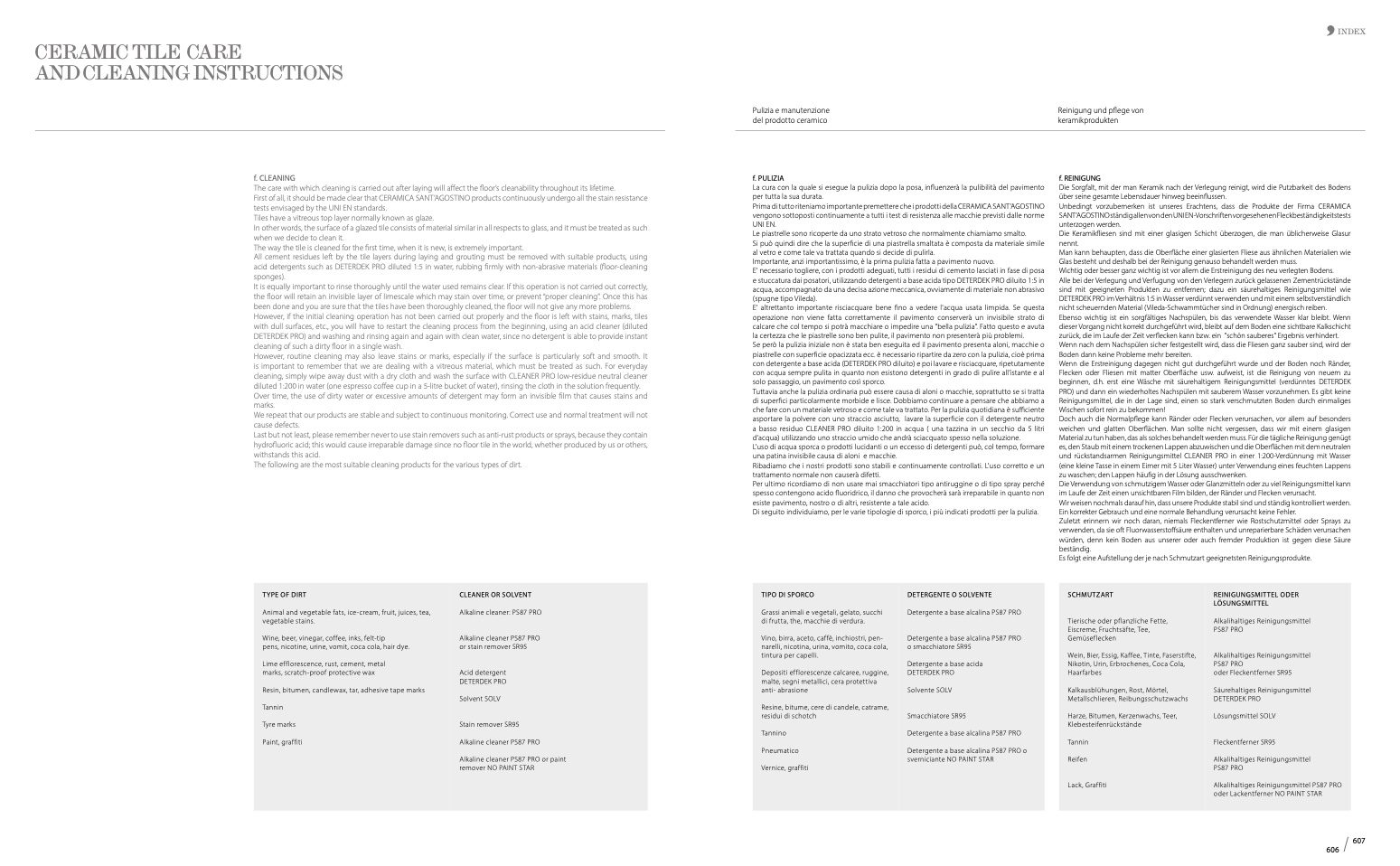
The following are the most suitable cleaning products for the various types of dirt.
Pulizia e manutenzione
del prodotto ceramico
f. PULIZIA
La cura con la quale si esegue la pulizia dopo la posa, influenzerà la pulibilità del pavimento
per tutta la sua durata.
Prima di tutto riteniamo importante premettere che i prodotti della CERAMICA SANT’AGOSTINO
vengono sottoposti continuamente a tutti i test di resistenza alle macchie previsti dalle norme
UNI EN.
Le piastrelle sono ricoperte da uno strato vetroso che normalmente chiamiamo smalto.
Si può quindi dire che la superficie di una piastrella smaltata è composta da materiale simile
al vetro e come tale va trattata quando si decide di pulirla.
Importante, anzi importantissimo, è la prima pulizia fatta a pavimento nuovo.
E' necessario togliere, con i prodotti adeguati, tutti i residui di cemento lasciati in fase di posa
e stuccatura dai posatori, utilizzando detergenti a base acida tipo DETERDEK PRO diluito 1:5 in
acqua, accompagnato da una decisa azione meccanica, ovviamente di materiale non abrasivo
(spugne tipo Vileda).
E' altrettanto importante risciacquare bene fino a vedere l'acqua usata limpida. Se questa
operazione non viene fatta correttamente il pavimento conserverà un invisibile strato di
calcare che col tempo si potrà macchiare o impedire una "bella pulizia". Fatto questo e avuta
la certezza che le piastrelle sono ben pulite, il pavimento non presenterà più problemi.
Se però la pulizia iniziale non è stata ben eseguita ed il pavimento presenta aloni, macchie o
piastrelle con superficie opacizzata ecc. è necessario ripartire da zero con la pulizia, cioè prima
con detergente a base acida (DETERDEK PRO diluito) e poi lavare e risciacquare, ripetutamente
con acqua sempre pulita in quanto non esistono detergenti in grado di pulire all’istante e al
solo passaggio, un pavimento così sporco.
Tuttavia anche la pulizia ordinaria può essere causa di aloni o macchie, soprattutto se si tratta
di superfici particolarmente morbide e lisce. Dobbiamo continuare a pensare che abbiamo a
che fare con un materiale vetroso e come tale va trattato. Per la pulizia quotidiana è sufficiente
asportare la polvere con uno straccio asciutto, lavare la superficie con il detergente neutro
a basso residuo CLEANER PRO diluito 1:200 in acqua ( una tazzina in un secchio da 5 litri
d’acqua) utilizzando uno straccio umido che andrà sciacquato spesso nella soluzione.
L'uso di acqua sporca o prodotti lucidanti o un eccesso di detergenti può, col tempo, formare
una patina invisibile causa di aloni e macchie.
Ribadiamo che i nostri prodotti sono stabili e continuamente controllati. L'uso corretto e un
trattamento normale non causerà difetti.
Per ultimo ricordiamo di non usare mai smacchiatori tipo antiruggine o di tipo spray perché
spesso contengono acido fluoridrico, il danno che provocherà sarà irreparabile in quanto non
esiste pavimento, nostro o di altri, resistente a tale acido.
Di seguito individuiamo, per le varie tipologie di sporco, i più indicati prodotti per la pulizia.
Reinigung und pflege von
keramikprodukten
f. REINIGUNG
Die Sorgfalt, mit der man Keramik nach der Verlegung reinigt, wird die Putzbarkeit des Bodens
über seine gesamte Lebensdauer hinweg beeinflussen.
Unbedingt vorzubemerken ist unseres Erachtens, dass die Produkte der Firma CERAMICA
SANT’AGOSTINOständigallenvondenUNIEN-VorschriftenvorgesehenenFleckbeständigkeitstests
unterzogen werden.
Die Keramikfliesen sind mit einer glasigen Schicht überzogen, die man üblicherweise Glasur
nennt.
Man kann behaupten, dass die Oberfläche einer glasierten Fliese aus ähnlichen Materialien wie
Glas besteht und deshalb bei der Reinigung genauso behandelt werden muss.
Wichtig oder besser ganz wichtig ist vor allem die Erstreinigung des neu verlegten Bodens.
Alle bei der Verlegung und Verfugung von den Verlegern zurück gelassenen Zementrückstände
sind mit geeigneten Produkten zu entfernen; dazu ein säurehaltiges Reinigungsmittel wie
DETERDEK PRO im Verhältnis 1:5 in Wasser verdünnt verwenden und mit einem selbstverständlich
nicht scheuernden Material (Vileda-Schwammtücher sind in Ordnung) energisch reiben.
Ebenso wichtig ist ein sorgfältiges Nachspülen, bis das verwendete Wasser klar bleibt. Wenn
dieser Vorgang nicht korrekt durchgeführt wird, bleibt auf dem Boden eine sichtbare Kalkschicht
zurück, die im Laufe der Zeit verflecken kann bzw. ein "schön sauberes" Ergebnis verhindert.
Wenn nach dem Nachspülen sicher festgestellt wird, dass die Fliesen ganz sauber sind, wird der
Boden dann keine Probleme mehr bereiten.
Wenn die Erstreinigung dagegen nicht gut durchgeführt wurde und der Boden noch Ränder,
Flecken oder Fliesen mit matter Oberfläche usw. aufweist, ist die Reinigung von neuem zu
beginnen, d.h. erst eine Wäsche mit säurehaltigem Reinigungsmittel (verdünntes DETERDEK
PRO) und dann ein wiederholtes Nachspülen mit sauberem Wasser vorzunehmen. Es gibt keine
Reinigungsmittel, die in der Lage sind, einen so stark verschmutzten Boden durch einmaliges
Wischen sofort rein zu bekommen!
Doch auch die Normalpflege kann Ränder oder Flecken verursachen, vor allem auf besonders
weichen und glatten Oberflächen. Man sollte nicht vergessen, dass wir mit einem glasigen
Material zu tun haben, das als solches behandelt werden muss. Für die tägliche Reinigung genügt
es, den Staub mit einem trockenen Lappen abzuwischen und die Oberflächen mit dem neutralen
und rückstandsarmen Reinigungsmittel CLEANER PRO in einer 1:200-Verdünnung mit Wasser
(eine kleine Tasse in einem Eimer mit 5 Liter Wasser) unter Verwendung eines feuchten Lappens
zu waschen; den Lappen häufig in der Lösung ausschwenken.
Die Verwendung von schmutzigem Wasser oder Glanzmitteln oder zu viel Reinigungsmittel kann
im Laufe der Zeit einen unsichtbaren Film bilden, der Ränder und Flecken verursacht.
Wir weisen nochmals darauf hin, dass unsere Produkte stabil sind und ständig kontrolliert werden.
Ein korrekter Gebrauch und eine normale Behandlung verursacht keine Fehler.
Zuletzt erinnern wir noch daran, niemals Fleckentferner wie Rostschutzmittel oder Sprays zu
verwenden, da sie oft Fluorwasserstoffsäure enthalten und unreparierbare Schäden verursachen
würden, denn kein Boden aus unserer oder auch fremder Produktion ist gegen diese Säure
beständig.
Es folgt eine Aufstellung der je nach Schmutzart geeignetsten Reinigungsprodukte.
INDEX
TYPE OF DIRT
Animal and vegetable fats, ice-cream, fruit, juices, tea,
vegetable stains.
Wine, beer, vinegar, coffee, inks, felt-tip
pens, nicotine, urine, vomit, coca cola, hair dye.
Lime efflorescence, rust, cement, metal
marks, scratch-proof protective wax
Resin, bitumen, candlewax, tar, adhesive tape marks
Tannin
Tyre marks
Paint, graffiti
CLEANER OR SOLVENT
Alkaline cleaner: PS87 PRO
Alkaline cleaner PS87 PRO
or stain remover SR95
Acid detergent
DETERDEK PRO
Solvent SOLV
Stain remover SR95
Alkaline cleaner PS87 PRO
Alkaline cleaner PS87 PRO or paint
remover NO PAINT STAR
TIPO DI SPORCO
Grassi animali e vegetali, gelato, succhi
di frutta, the, macchie di verdura.
Vino, birra, aceto, caffè, inchiostri, pen-
narelli, nicotina, urina, vomito, coca cola,
tintura per capelli.
Depositi efflorescenze calcaree, ruggine,
malte, segni metallici, cera protettiva
anti- abrasione
Resine, bitume, cere di candele, catrame,
residui di schotch
Tannino
Pneumatico
Vernice, graffiti
DETERGENTE O SOLVENTE
Detergente a base alcalina PS87 PRO
Detergente a base alcalina PS87 PRO
o smacchiatore SR95
Detergente a base acida
DETERDEK PRO
Solvente SOLV
Smacchiatore SR95
Detergente a base alcalina PS87 PRO
Detergente a base alcalina PS87 PRO o
sverniciante NO PAINT STAR
SCHMUTZART
Tierische oder pflanzliche Fette,
Eiscreme, Fruchtsäfte, Tee,
Gemüseflecken
Wein, Bier, Essig, Kaffee, Tinte, Faserstifte,
Nikotin, Urin, Erbrochenes, Coca Cola,
Haarfarbes
Kalkausblühungen, Rost, Mörtel,
Metallschlieren, Reibungsschutzwachs
Harze, Bitumen, Kerzenwachs, Teer,
Klebesteifenrückstände
Tannin
Reifen
Lack, Graffiti
REINIGUNGSMITTEL ODER
LÖSUNGSMITTEL
Alkalihaltiges Reinigungsmittel
PS87 PRO
Alkalihaltiges Reinigungsmittel
PS87 PRO
oder Fleckentferner SR95
Säurehaltiges Reinigungsmittel
DETERDEK PRO
Lösungsmittel SOLV
Fleckentferner SR95
Alkalihaltiges Reinigungsmittel
PS87 PRO
Alkalihaltiges Reinigungsmittel PS87 PRO
oder Lackentferner NO PAINT STAR
607
606

