WORKBOOK
EXTRA THICK
Posa a Colla su Massetto
– Laying on Screed with Adhesive • Pose Collée sur Chape • Verlegung im Kleberbett auf Estrich • Colocación con Cola Sobre
Capa de Relleno • Наклеивание на Стяжку
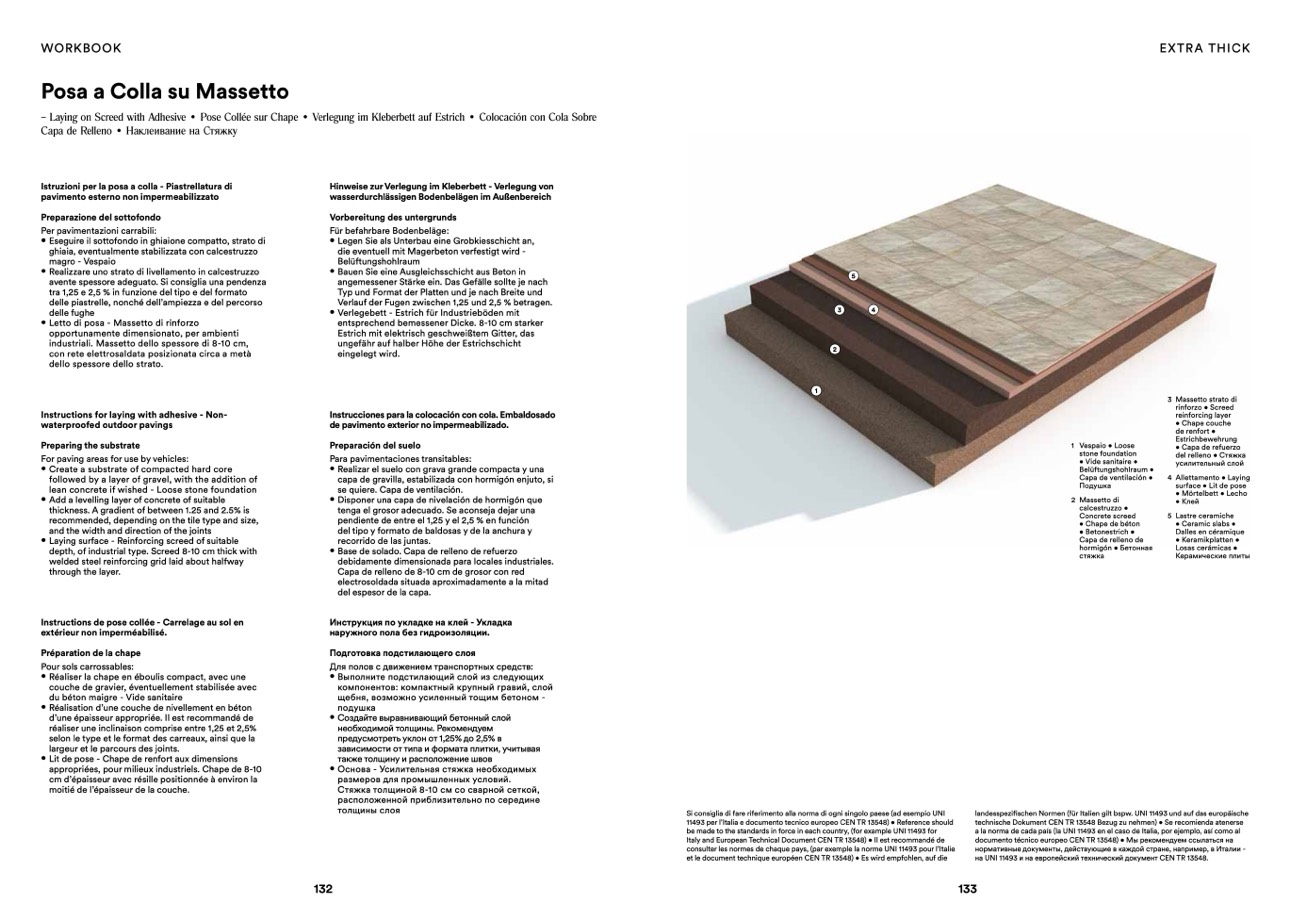
5
3
4
2
1
3 Massetto strato di
rinforzo • Screed
reinforcing layer
• Chape couche
de renfort •
Estrichbewehrung
• Capa de refuerzo
del relleno • Стяжка
усилительный слой
4 Allettamento • Laying
surface • Lit de pose
• Mörtelbett • Lecho
• Клей
5 Lastre ceramiche
• Ceramic slabs •
Dalles en céramique
• Keramikplatten •
Losas cerámicas •
Керамические плиты
1 Vespaio • Loose
stone foundation
• Vide sanitaire •
Belüftungshohlraum •
Capa de ventilación •
Подушка
2 Massetto di
calcestruzzo •
Concrete screed
• Chape de béton
• Betonestrich •
Capa de relleno de
hormigón • Бетонная
стяжка
Istruzioni per la posa a colla - Piastrellatura di
pavimento esterno non impermeabilizzato
Preparazione del sottofondo
Per pavimentazioni carrabili:
• Eseguire il sottofondo in ghiaione compatto, strato di
ghiaia, eventualmente stabilizzata con calcestruzzo
magro - Vespaio
• Realizzare uno strato di livellamento in calcestruzzo
Hinweise zur Verlegung im Kleberbett - Verlegung von
wasserdurchlässigen Bodenbelägen im Außenbereich
Vorbereitung des untergrunds
Für befahrbare Bodenbeläge:
• Legen Sie als Unterbau eine Grobkiesschicht an,
die eventuell mit Magerbeton verfestigt wird -
Belüftungshohlraum
• Bauen Sie eine Ausgleichsschicht aus Beton in
avente spessore adeguato. Si consiglia una pendenza
tra 1,25 e 2,5 % in funzione del tipo e del formato
delle piastrelle, nonché dell’ampiezza e del percorso
delle fughe
angemessener Stärke ein. Das Gefälle sollte je nach
Typ und Format der Platten und je nach Breite und
Verlauf der Fugen zwischen 1,25 und 2,5 % betragen.
• Letto di posa - Massetto di rinforzo
opportunamente dimensionato, per ambienti
industriali. Massetto dello spessore di 8-10 cm,
con rete elettrosaldata posizionata circa a metà
dello spessore dello strato.
• Verlegebett - Estrich für Industrieböden mit
entsprechend bemessener Dicke. 8-10 cm starker
Estrich mit elektrisch geschweißtem Gitter, das
ungefähr auf halber Höhe der Estrichschicht
eingelegt wird.
Instructions for laying with adhesive - Non-
waterproofed outdoor pavings
Preparing the substrate
For paving areas for use by vehicles:
• Create a substrate of compacted hard core
followed by a layer of gravel, with the addition of
lean concrete if wished - Loose stone foundation
• Add a levelling layer of concrete of suitable
Instrucciones para la colocación con cola. Embaldosado
de pavimento exterior no impermeabilizado.
Preparación del suelo
Para pavimentaciones transitables:
• Realizar el suelo con grava grande compacta y una
capa de gravilla, estabilizada con hormigón enjuto, si
se quiere. Capa de ventilación.
• Disponer una capa de nivelación de hormigón que
thickness. A gradient of between 1.25 and 2.5% is
recommended, depending on the tile type and size,
and the width and direction of the joints
tenga el grosor adecuado. Se aconseja dejar una
pendiente de entre el 1,25 y el 2,5 % en función
del tipo y formato de baldosas y de la anchura y
recorrido de las juntas.
• Laying surface - Reinforcing screed of suitable
depth, of industrial type. Screed 8-10 cm thick with
welded steel reinforcing grid laid about halfway
through the layer.
• Base de solado. Capa de relleno de refuerzo
debidamente dimensionada para locales industriales.
Capa de relleno de 8-10 cm de grosor con red
electrosoldada situada aproximadamente a la mitad
del espesor de la capa.
Instructions de pose collée - Carrelage au sol en
extérieur non imperméabilisé.
Préparation de la chape
Pour sols carrossables:
• Réaliser la chape en éboulis compact, avec une
couche de gravier, éventuellement stabilisée avec
du béton maigre - Vide sanitaire
• Réalisation d’une couche de nivellement en béton
Инструкция по укладке на клей - Укладка
наружного пола без гидроизоляции.
Подготовка подстилающего слоя
Для полов с движением транспортных средств:
• Выполните подстилающий слой из следующих
d’une épaisseur appropriée. Il est recommandé de
réaliser une inclinaison comprise entre 1,25 et 2,5%
selon le type et le format des carreaux, ainsi que la
largeur et le parcours des joints.
• Создайте выравнивающий бетонный слой
необходимой толщины. Рекомендуем
предусмотреть уклон от 1,25% до 2,5% в
зависимости от типа и формата плитки, учитывая
также толщину и расположение швов
• Lit de pose - Chape de renfort aux dimensions
appropriées, pour milieux industriels. Chape de 8-10
cm d’épaisseur avec résille positionnée à environ la
moitié de l’épaisseur de la couche.
• Основа - Усилительная стяжка необходимых
размеров для промышленных условий.
Стяжка толщиной 8-10 см со сварной сеткой,
расположенной приблизительно по середине
толщины слоя
132
133
компонентов: компактный крупный гравий, слой
щебня, возможно усиленный тощим бетоном -
подушка
Si consiglia di fare riferimento alla norma di ogni singolo paese (ad esempio UNI
11493 per l’Italia e documento tecnico europeo CEN TR 13548) • Reference should
be made to the standards in force in each country, (for example UNI 11493 for
Italy and European Technical Document CEN TR 13548) • Il est recommandé de
consulter les normes de chaque pays, (par exemple la norme UNI 11493 pour l’Italie
et le document technique européen CEN TR 13548) • Es wird empfohlen, auf die
landesspezifischen Normen (für Italien gilt bspw. UNI 11493 und auf das europäische
technische Dokument CEN TR 13548 Bezug zu nehmen) • Se recomienda atenerse
a la norma de cada país (la UNI 11493 en el caso de Italia, por ejemplo, así como al
documento técnico europeo CEN TR 13548) • Мы рекомендуем ссылаться на
нормативные документы, действующие в каждой стране, например, в Италии -
на UNI 11493 и на европейский технический документ CEN TR 13548.

