WORKBOOK
EXTRA THICK
Posa a Secco su Ghiaia
– Dry Laying on Gravel • Pose à Sec sur le Gravier • Trockenverlegung auf Kies • Colocación en Seco sobre Grava
• Сухая Укладка на Щебень
Istruzioni per la posa a secco su ghiaia
1 Preparazione del Sottofondo
Instructions for dry laying on gravel
1 Preparing the substrate
• La posa su ghiaia permette di pavimentare in assenza
di un supporto di cemento.
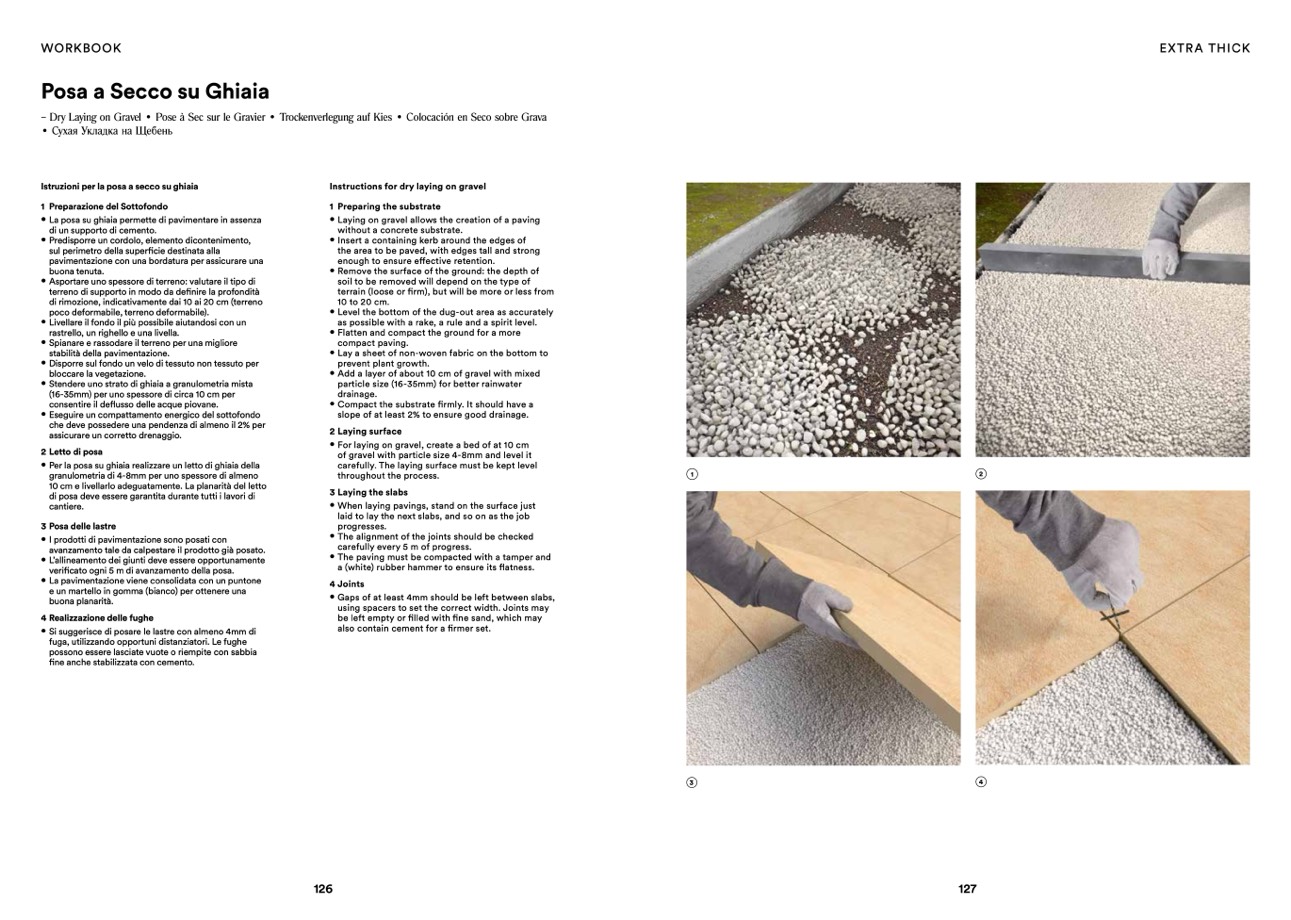
• Laying on gravel allows the creation of a paving
without a concrete substrate.
• Predisporre un cordolo, elemento dicontenimento,
sul perimetro della superficie destinata alla
pavimentazione con una bordatura per assicurare una
buona tenuta.
• Insert a containing kerb around the edges of
the area to be paved, with edges tall and strong
enough to ensure effective retention.
• Asportare uno spessore di terreno: valutare il tipo di
terreno di supporto in modo da definire la profondità
di rimozione, indicativamente dai 10 ai 20 cm (terreno
poco deformabile, terreno deformabile).
• Remove the surface of the ground: the depth of
soil to be removed will depend on the type of
terrain (loose or firm), but will be more or less from
10to20cm.
• Livellare il fondo il più possibile aiutandosi con un
rastrello, un righello e una livella.
• Level the bottom of the dug-out area as accurately
as possible with a rake, a rule and a spirit level.
• Spianare e rassodare il terreno per una migliore
stabilità della pavimentazione.
• Flatten and compact the ground for a more
compact paving.
• Disporre sul fondo un velo di tessuto non tessuto per
bloccare la vegetazione.
• Lay a sheet of non-woven fabric on the bottom to
prevent plant growth.
• Stendere uno strato di ghiaia a granulometria mista
(16-35mm) per uno spessore di circa 10 cm per
consentire il deflusso delle acque piovane.
• Add a layer of about 10 cm of gravel with mixed
particle size (16-35mm) for better rainwater
drainage.
• Eseguire un compattamento energico del sottofondo
che deve possedere una pendenza di almeno il 2% per
assicurare un corretto drenaggio.
• Compact the substrate firmly. It should have a
slope of at least 2% to ensure good drainage.
2 Letto di posa
• Per la posa su ghiaia realizzare un letto di ghiaia della
granulometria di 4-8mm per uno spessore di almeno
10 cm e livellarlo adeguatamente. La planarità del letto
di posa deve essere garantita durante tutti i lavori di
cantiere.
3 Posa delle lastre
• I prodotti di pavimentazione sono posati con
avanzamento tale da calpestare il prodotto già posato.
• L’allineamento dei giunti deve essere opportunamente
verificato ogni 5 m di avanzamento della posa.
• La pavimentazione viene consolidata con un puntone
e un martello in gomma (bianco) per ottenere una
buona planarità.
4 Realizzazione delle fughe
• Si suggerisce di posare le lastre con almeno 4mm di
fuga, utilizzando opportuni distanziatori. Le fughe
possono essere lasciate vuote o riempite con sabbia
fine anche stabilizzata con cemento.
2 Laying surface
• For laying on gravel, create a bed of at 10 cm
of gravel with particle size 4-8mm and level it
carefully. The laying surface must be kept level
throughout the process.
3 Laying the slabs
1
2
• When laying pavings, stand on the surface just
laid to lay the next slabs, and so on as the job
progresses.
• The alignment of the joints should be checked
carefully every 5 m of progress.
• The paving must be compacted with a tamper and
a (white) rubber hammer to ensure its flatness.
4 Joints
• Gaps of at least 4mm should be left between slabs,
using spacers to set the correct width. Joints may
be left empty or filled with fine sand, which may
also contain cement for a firmer set.
3
4
126
127

