TECHNICAL ADVICES
MARMERIA
LAYING. Laying Boxer marbles is extremely simple since it can be done
with both mortar and suitable adhesives easily found on the market. To this
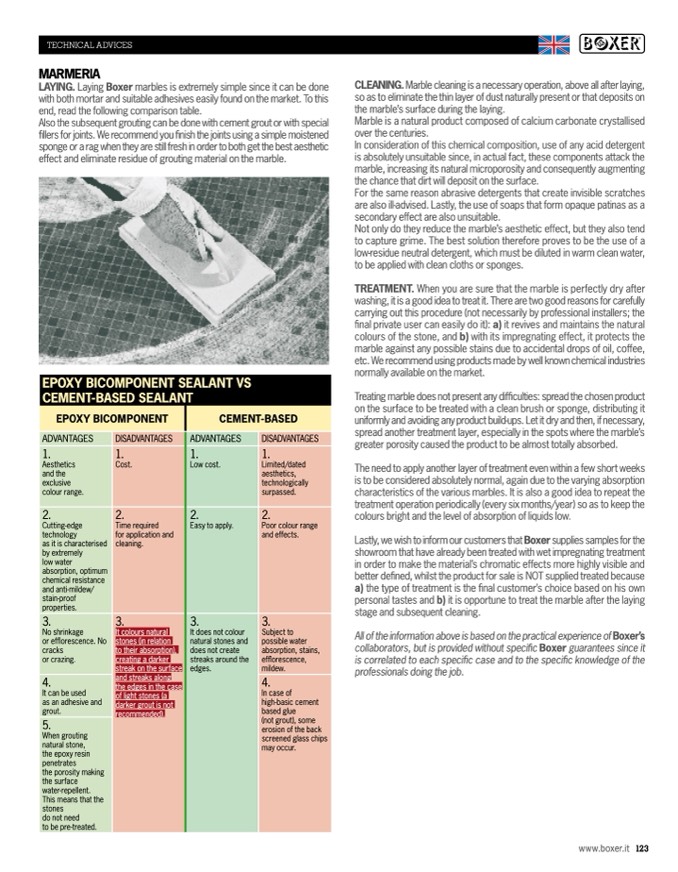
end, read the following comparison table.
Also the subsequent grouting can be done with cement grout or with special
fillers for joints. We recommend you finish the joints using a simple moistened
sponge or a rag when they are still fresh in order to both get the best aesthetic
effect and eliminate residue of grouting material on the marble.
CLEANING. Marble cleaning is a necessary operation, above all after laying,
so as to eliminate the thin layer of dust naturally present or that deposits on
the marble’s surface during the laying.
Marble is a natural product composed of calcium carbonate crystallised
over the centuries.
In consideration of this chemical composition, use of any acid detergent
is absolutely unsuitable since, in actual fact, these components attack the
marble, increasing its natural microporosity and consequently augmenting
the chance that dirt will deposit on the surface.
For the same reason abrasive detergents that create invisible scratches
are also ill-advised. Lastly, the use of soaps that form opaque patinas as a
secondary effect are also unsuitable.
Not only do they reduce the marble’s aesthetic effect, but they also tend
to capture grime. The best solution therefore proves to be the use of a
low-residue neutral detergent, which must be diluted in warm clean water,
to be applied with clean cloths or sponges.
TREATMENT. When you are sure that the marble is perfectly dry after
washing, it is a good idea to treat it. There are two good reasons for carefully
carrying out this procedure (not necessarily by professional installers; the
final private user can easily do it): a) it revives and maintains the natural
colours of the stone, and b) with its impregnating effect, it protects the
marble against any possible stains due to accidental drops of oil, coffee,
etc. We recommend using products made by well known chemical industries
normally available on the market.
Treating marble does not present any difficulties: spread the chosen product
on the surface to be treated with a clean brush or sponge, distributing it
uniformly and avoiding any product build-ups. Let it dry and then, if necessary,
spread another treatment layer, especially in the spots where the marble’s
greater porosity caused the product to be almost totally absorbed.
The need to apply another layer of treatment even within a few short weeks
is to be considered absolutely normal, again due to the varying absorption
characteristics of the various marbles. It is also a good idea to repeat the
treatment operation periodically (every six months/year) so as to keep the
colours bright and the level of absorption of liquids low.
Lastly, we wish to inform our customers that Boxer supplies samples for the
showroom that have already been treated with wet impregnating treatment
in order to make the material’s chromatic effects more highly visible and
better defined, whilst the product for sale is NOT supplied treated because
a) the type of treatment is the final customer’s choice based on his own
personal tastes and b) it is opportune to treat the marble after the laying
stage and subsequent cleaning.
All of the information above is based on the practical experience of Boxer’s
collaborators, but is provided without specific Boxer guarantees since it
is correlated to each specific case and to the specific knowledge of the
professionals doing the job.
EPOXY BICOMPONENT SEALANT VS
CEMENT-BASED SEALANT
EPOXY BICOMPONENT
CEMENT-BASED
ADVANTAGES
DISADVANTAGES
ADVANTAGES
DISADVANTAGES
1.
Aesthetics
and the
exclusive
colour range.
1.
Cost.
1.
Low cost.
1.
Limited/dated
aesthetics,
technologically
surpassed.
2.
Cutting-edge
technology
as it is characterised
by extremely
low water
absorption, optimum
chemical resistance
and anti-mildew/
stain-proof
properties.
2.
Time required
for application and
cleaning.
2.
Easy to apply.
2.
Poor colour range
and effects.
3.
No shrinkage
or efflorescence. No
cracks
or crazing.
3.
It colours natural
stones (in relation
to their absorption),
creating a darker
streak on the surface
and streaks along
the edges in the case
of light stones (a
darker grout is not
recommended).
3.
It does not colour
natural stones and
does not create
streaks around the
edges.
3.
Subject to
possible water
absorption, stains,
efflorescence,
mildew.
4.
It can be used
as an adhesive and
grout.
4.
In case of
high-basic cement
based glue
(not grout), some
erosion of the back
screened glass chips
may occur.
5.
When grouting
natural stone,
the epoxy resin
penetrates
the porosity making
the surface
water-repellent.
This means that the
stones
do not need
to be pre-treated.
www.boxer.it 123

