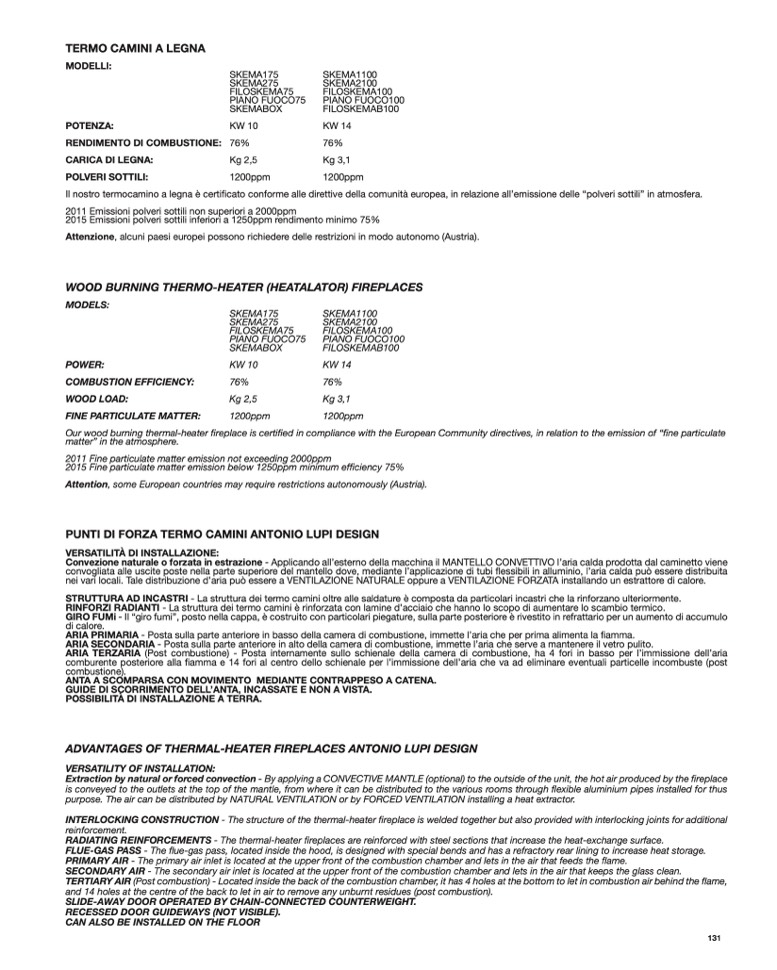
TERMO CAMINI A LEGNA
MODELLI:
POTENZA:
RENDIMENTO DI COMBUSTIONE:
CARICA DI LEGNA:
POLVERI SOTTILI:
SKEMA175
SKEMA275
FILOSKEMA75
PIANO FUOCO75
SKEMABOX
KW 10
76%
Kg 2,5
1200ppm
SKEMA1100
SKEMA2100
FILOSKEMA100
PIANO FUOCO100
FILOSKEMAB100
KW 14
76%
Kg 3,1
1200ppm
Il nostro termocamino a legna è certificato conforme alle direttive della comunit
à europea, in relazione all’emissione delle “polveri sottili” in atmosfera.
2015 Emissioni polveri sottili inferiori a 1250ppm rendimento minimo 75%
Attenzione, alcuni paesi europei possono richiedere delle restrizioni in modo autonomo (Austria).
WOOD BURNING THERMO-HEATER (HEATALATOR) FIREPLACES
2011 Emissioni polveri sottili non superiori a 2000ppm
MODELS:
POWER:
COMBUSTION EFFICIENCY:
WOOD LOAD:
FINE PARTICULATE MATTER:
SKEMA175
SKEMA275
FILOSKEMA75
PIANO FUOCO75
SKEMABOX
KW 10
76%
Kg 2,5
1200ppm
SKEMA1100
SKEMA2100
FILOSKEMA100
PIANO FUOCO100
FILOSKEMAB100
KW 14
76%
Kg 3,1
1200ppm
Our wood burning thermal-heater fireplace is certified in compliance with the European Community directives, in relation to the emission of “fine particulate
2011 Fine particulate matter emission not exceeding 2000ppm
2015 Fine particulate matter emission below 1250ppm minimum ef
ficiency 75%
Attention, some European countries may require restrictions autonomously (Austria).
PUNTI DI FORZA TERMO CAMINI ANTONIO LUPI DESIGN
VERSATILITÀ DI INSTALLAZIONE:
Convezione naturale o forzata in estrazione - Applicando all’esterno della macchina il MANTELLO CONVETTIVO l’aria calda prodotta dal caminetto viene
convogliata alle uscite poste nella parte superiore del mantello dove, mediante l’applicazione di tubi
flessibili in alluminio, l’aria calda può essere distribuita
nei vari locali. Tale distribuzione d’aria può essere a VENTILAZIONE NATURALE oppure a VENTILAZIONE FORZATA installando un estrattore di calore.
STRUTTURA AD INCASTRI - La struttura dei termo camini oltre alle saldature
è composta da particolari incastri che la rinforzano ulteriormente.
RINFORZI RADIANTI - La struttura dei termo camini è rinforzata con lamine d’acciaio che hanno lo scopo di aumentare lo scambio termico.
GIRO FUMi - Il “giro fumi”, posto nella cappa,
è costruito con particolari piegature, sulla parte posteriore è rivestito in refrattario per un aumento di accumulo
di calore.
ARIA PRIMARIA - Posta sulla parte anteriore in basso della camera di combustione, immette l’aria che per prima alimenta la fiamma.
ARIA SECONDARIA - Posta sulla parte anteriore in alto della camera di combustione, immette l’aria che serve a mantenere il vetro pulito.
ARIA TERZARIA (Post combustione) - Posta internamente sullo schienale della camera di combustione, ha 4 fori in basso per l’immissione dell’aria
comburente posteriore alla fiamma e 14 fori al centro dello schienale per l’immissione dell’aria che va ad eliminare eventuali particelle incombuste (post
combustione).
ANTA A SCOMPARSA CON MOVIMENTO MEDIANTE CONTRAPPESO A CATENA.
GUIDE DI SCORRIMENTO DELL’ANTA, INCASSATE E NON A VISTA.
POSSIBILITÀ DI INSTALLAZIONE A TERRA.
ADVANTAGES OF THERMAL-HEATER FIREPLACES ANTONIO LUPI DESIGN
VERSATILITY OF INSTALLATION:
Extraction by natural or forced convection - By applying a CONVECTIVE MANTLE (optional) to the outside of the unit, the hot air produced by the fireplace
is conveyed to the outlets at the top of the mantle, from where it can be distributed to the various rooms through flexible aluminium pipes installed for thus
purpose. The air can be distributed by NATURAL VENTILATION or by FORCED VENTILATION installing a heat extractor.
INTERLOCKING CONSTRUCTION - The structure of the thermal-heater fireplace is welded together but also provided with interlocking joints for additional
reinforcement.
RADIATING REINFORCEMENTS - The thermal-heater fireplaces are reinforced with steel sections that increase the heat-exchange surface.
FLUE-GAS PASS - The flue-gas pass, located inside the hood, is designed with special bends and has a refractory rear lining to increase heat storage.
PRIMARY AIR - The primary air inlet is located at the upper front of the combustion chamber and lets in the air that feeds the flame.
SECONDARY AIR - The secondary air inlet is located at the upper front of the combustion chamber and lets in the air that keeps the glass clean.
TERTIARY AIR (Post combustion) - Located inside the back of the combustion chamber, it has 4 holes at the bottom to let in combustion air behind the flame,
and 14 holes at the centre of the back to let in air to remove any unburnt residues (post combustion).
SLIDE-AWAY DOOR OPERATED BY CHAIN-CONNECTED COUNTERWEIGHT.
RECESSED DOOR GUIDEWAYS (NOT VISIBLE).
CAN ALSO BE INSTALLED ON THE FLOOR
matter” in the atmosphere.
131

